


Artificial intelligence, landmark IPOs, persistent inflation, geopolitical conflicts, and trade disputes headlined markets in 2026 as the S&P 500 reached new all-time highs—although it retraced some of those gains in October and November. At the sector level, energy and some defensive sectors are on pace to outperform cyclical sectors.
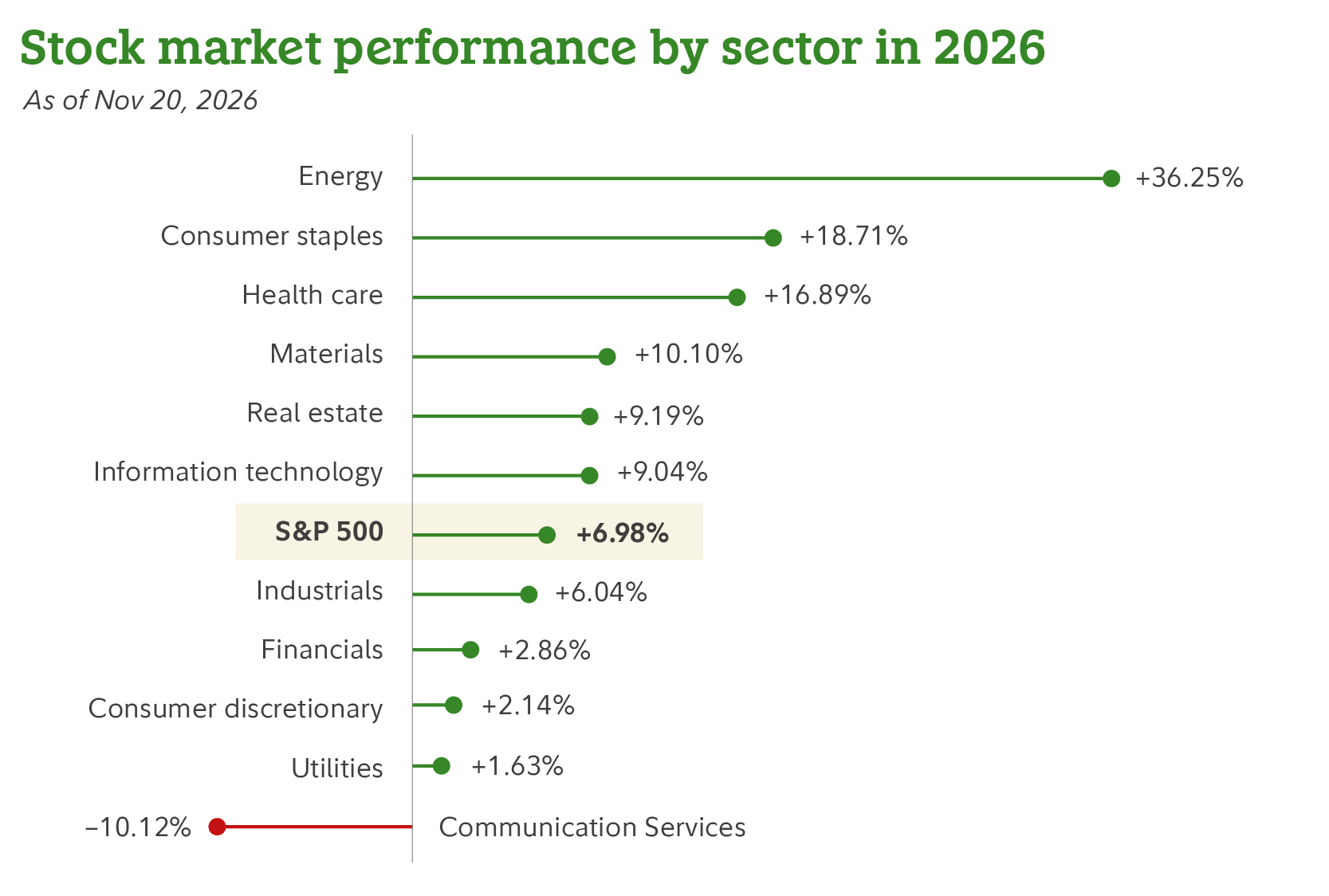
Looking ahead to 2027, themes like infrastructure, electrification, and biotechnology—in addition to artificial intelligence—may offer compelling opportunities. Here are investing ideas from Fidelity portfolio managers to consider across all 11 sectors.
Communication services
Priyanshu Bakshi, Fidelity® Select Communication Services Portfolio (
Despite the uptick in volatility and weak performance for the communication services sector in 2026, I remain cautiously optimistic about 2027 where artificial intelligence remains the most powerful driver of growth. Business fundamentals for many of these companies with exposure to the AI boom are largely steady. Spending on AI infrastructure and innovation remains on track, which may push revenue and longer-term prospects higher for many companies in the sector. I believe the growth of AI will likely benefit hyperscalers (companies that operate vast cloud-computing networks) that are firmly entrenched with consumers and enterprises and can invest in AI infrastructure and applications.
Elsewhere in the sector, legacy communication services companies—most notably in the wireless telecom services, cable & satellite, and integrated telecom services categories—are under pressure. These companies are often considered more defensive investments, proving somewhat resilient when the equity market pulls back, but lagging when it reverses course and runs higher. However, they are facing secular challenges, including declining subscriptions, high churn, and increased competition from new entrants.
Consumer discretionary
Ben Shuleva, Fidelity® Select Consumer Discretionary Fund (
The consumer outlook remains clouded by near-term risks and uncertainty—including stubborn inflation and relatively high rates. However, the sector’s wide range of stocks and industries offers plenty of opportunities to uncover pockets of value. For example, I'm looking at the US housing market, which has endured a four-year cyclical downturn with home turnover at historic lows amid elevated mortgage rates and weak sales. The prolonged slump has weighed on the stock valuations of home improvement and home furnishing retailers, creating a compelling entry point. Much of the recent home-improvement spending has been concentrated on essential maintenance, while larger discretionary projects have remained subdued, leaving room for a potential rebound. The replacement cycle for products purchased during the pandemic-era surge in home improvement is also approaching.
I’m also gaining interest in auto parts retailers, where stocks are trading near their cheapest levels in 18 months, as of late November, due to tariffs and inflation driving profit margin uncertainty. These high-quality defensive businesses have historically been well positioned to weather inflation, thanks to strong pricing power and the ability to pass higher costs to customers. Additionally, demand should strengthen as customers may put off buying a new car if costs rise, but they can’t indefinitely delay replacing a failed alternator, battery, or brake system.
Consumer staples
Ben Shuleva, Fidelity® Select Consumer Staples Portfolio (
Recent market dynamics have reinforced the role consumer staples can play in a diversified portfolio. In 2027, I expect inflation to test the sector. However, I believe companies with favorable market structures and distinct company-specific catalysts are best positioned to come out ahead.
For example, beverage companies with consolidated industries and strong pricing power, along with grocery retailers, may be best positioned to navigate this environment. Grocery retailers have historically held up well during periods of modestly higher inflation, as rising prices allow grocers to spread labor costs across a larger sales base.
Energy
Kristen Dougherty, Fidelity® Select Energy Portfolio (
Energy stocks soared in 2026, as of late November, amid a series of geopolitical events that disrupted global energy markets in a fashion not seen in decades. While I believe global oil and refined product prices will remain volatile in 2027 due to uneven progress toward the resolution of geopolitical conflicts, I think the outlook for the energy sector is solid. Energy markets have demonstrated their ability to adapt to historic levels of disruption without creating a material drag on global economic growth, and that disruption may incentivize long-term projects that further bolster and diversify energy supply. In the short term, I expect gradual restocking in energy commodities to temporarily bolster demand, and I expect producers in the Middle East to look to recapture lost market share when circumstances allow, which I think will benefit oilfield services companies that can deliver behind-the-meter power.
More broadly, I expect this environment to work to the advantage of energy producers that have a low through-cycle cost of supply because the path to geopolitical normalization will not necessarily be a smooth one, and this could cause volatility in commodity prices to persist. Lastly, certain power producers should benefit from the growth of artificial intelligence and demand for power. As it has become more difficult for new hyperscalers to connect to the grid, the market has shifted focus from independent power producers to behind-the-meter power-solution providers as the primary beneficiaries of AI.
Financials
Gerard Benson, Fidelity® Select Financials Portfolio (
In 2027, I’m optimistic about certain banks that continue to operate from a position of strength, supported by a positively sloping yield curve, solid loan growth, fee-income momentum, stable credit conditions, and expanding profitability. Meanwhile, much remains to be seen about the ultimate impact of the US midterm elections on financial stocks and the broader economy in areas like data-center build-out and capex implications, sentiment toward big banks, and credit card-related regulatory proposals.
Another industry I favor in the sector is retail brokers. Retail advisory firms have been rolling out new products and services—including private markets, alternative assets, crypto trading, and innovative lending products—that enhance the value proposition to clients and diversify sources of revenue. Additionally, I believe the value propositions of brokerage firms are intact and improving, and pricing models should evolve if the environment shifts. Thus, I view recent weakness in this industry as a buying opportunity.
Health Care
Eddie Yoon, Fidelity® Select Health Care Portfolio (
I expect the earnings growth of health care companies to accelerate in 2027, bringing the sector more in line with the broader market. Fundamentals are improving across most industries in the sector, with medical devices being the notable exception. Specifically, I see opportunities in the life sciences tools and services industry, where certain companies are positioned to benefit from the influence of artificial intelligence, and the industry moves beyond the post-COVID inventory build-up, allowing organic growth to accelerate. I believe increased research activity, an improving funding environment, and AI-related demand should continue to provide support for the industry.
Biotechnology is another bright spot, where I expect the robust M&A activity to carry into 2027. Large-cap pharmaceutical companies currently have more than $1 trillion to pour into acquisitions as they contend with patent cliffs through 2030, creating a strong incentive to pursue deals. In addition, several successful biotech launches this year have strengthened the industry’s fundamentals.
Industrials
Clayton Pfannenstiel, Fidelity® Select Industrials Portfolio (
The last 3 years saw stock performance in industrials led by structural themes such as long-cycle growth in AI infrastructure, aerospace, and transportation. I still like those themes. Notably, computing power is ultimately bound by the laws of thermodynamics. As hyperscale data centers pack dense racks of advanced graphics processing units (GPUs) and AI accelerators into tight footprints, thermal management has graduated from a back-of-house utility to one of the most mission-critical engineering challenges in the industrials sector. Within this landscape, complex climate-control systems built by pivotal industrial companies dictate whether multi-billion-dollar digital expansions succeed or fail. For example, some companies offer advanced cooling architectures and intelligent controls that actively reshape how the digital economy handles the extreme heat of AI workloads.
Elsewhere, I’m expecting further improvement in transportation equipment after years of underinvestment. Aging locomotive fleets may require upgrades as rail car volumes increase and locomotive production becomes oligopolistic. Heavy-duty trucks are in a similar position of potential undersupply and industry consolidation.
Technology
Priyanshu Bakshi, Fidelity® Select Technology Portfolio (
I remain excited about the potential for AI. That said, I am anticipating continued volatility in the information technology sector as the market parses the potential AI winners from the losers, and spending levels on AI infrastructure. While I believe the picks and shovels companies will continue to power the buildout of AI, I am expecting more focus on the next generation of AI “winners” to come from the application layer, and certain companies in the software and IT services industries appear well positioned.
And as artificial intelligence becomes more prevalent and risks increase, I believe cybersecurity companies present an opportunity as businesses look to shore up their defenses to emerging threats.
Materials
Ashley Fernandes, Fidelity® Select Materials Portfolio (
Though the macro picture is cloudy, I believe several materials industries are well-positioned for growth. I am a perennial champion of the long-term prospects for copper, an industry where supply is increasingly constrained while demand continues to grow. Among copper-intensive segments, electric-vehicle growth in the US and China has slowed but is persistent. Growth for renewable energy sources has moderately slowed in China but accelerated in the US and Europe. The expansion of electric-power capacity for AI data centers is a significant new source of copper demand. The copper market is often subject to near-term volatility, but I believe the long-term trend is inexorably upward.
Elsewhere, I think that geopolitical uncertainty and concerns about government debt levels could create a favorable backdrop for gold stocks in the coming year. Within the gold industry, I favor certain streaming and royalty firms. These businesses provide upfront financing to mining firms and then either receive a percentage of the eventual revenue (royalty) or gain the right to purchase the mined metals at fixed, contractual prices (streaming). In this business model, the firms can often exert an enviable amount of control over operating risk and revenue.
Real Estate
Steve Buller, Fidelity® Real Estate Investment Portfolio (
2026 was up-and-down for US real estate investment trusts (REITs), which began the year in strong fashion, but struggled for much of the second half as interest rates rose. Interest-rate and economically-sensitive sectors like real estate generally lagged amid the rising rate environment. Against this backdrop, challenges remain for REITs. But I am optimistic overall about the sector’s prospects in 2027.
I see compelling opportunities among industrial REITs, which after experiencing relative weakness earlier this year, could be poised to rebound given strong demand for modern logistics and distribution properties driven by growth in e-commerce and complex supply chains. In addition, with inflation elevated, construction costs for new buildings remain elevated, necessitating developers to charge higher rents to justify the construction. This has given owners of existing buildings more room to raise rents, which I expect to drive higher cash flows for REITs.
Utilities
Pranay Kirpalani, Fidelity® Select Utilities Portfolio (
I remain optimistic about the short- and long-term prospects for the utilities sector, given the massive investment in efforts to upgrade the grid and build out capacity for surging power demand. I believe this demand will continue due to the onshoring of manufacturing, increased penetration of electric-powered vehicles, heating/cooling and other devices in the US, and the growth of AI capabilities powered by data centers. Adoption of renewable energy sources by utilities will be an important component in filling the gap between supply and demand, given its cost advantage and flexibility, especially as power grids are updated.