


While sharply higher interest rates have made the stock market jittery, bond investors have had an opportunity to buy credit-risk-free Treasurys and high-quality corporate bonds at some of the highest yields seen in decades.
Where to find top bond yields
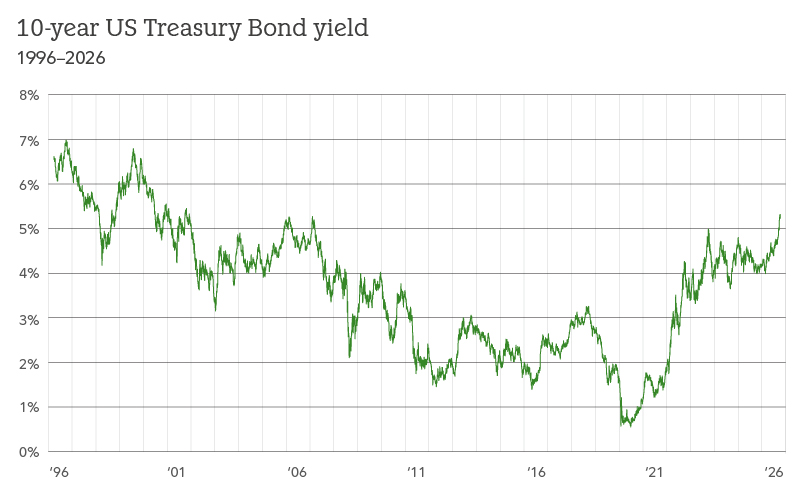
With yields elevated across the bond market and the Federal Reserve widely expected to continue hiking benchmark rates, investors have been able to earn higher income from bonds while providing greater balance to their portfolios. On Sept. 29, 2026, the 10-year US Treasury yield reached a fresh 19-year high, nearly matching rates last seen in 2002. The 30-year Treasury yield climbed to 2-decade highs.
“All in, bond rates look more attractive than they have in a long time,” says Beau Coash, Fidelity institutional portfolio manager team lead for fixed income. “You have to go back 2 decades to find yields as attractive as they are today.”
Where can investors find attractive bond yields now? Read on for a brief overview of the potential rewards and risks in different parts of the bond market.
Chart: 10-year US Treasury bond yields, 1996-2026
Short-term, high-quality bonds: Yields of around 5%
Using Fidelity’s fixed-income research tool, investors can quickly scan the highest and median yields of different kinds of securities, from Treasurys and corporates to municipal bonds and CDs. Investors have been able to buy bonds offering higher yields without having to take on lower-rated credits or commit to holding on for longer periods of time.
Backed by the US government, Treasury bonds are generally considered credit-risk-free. By contrast, top-rated corporate debt from the most creditworthy companies is typically considered to pose relatively low credit risk. In late September, investors could buy shorter-term, high-quality Treasurys and corporate bonds that yield around 5%.
While corporate issuers may offer somewhat higher yields than Treasurys, some Fidelity pros say investors should think twice, as credit-risk-free Treasury yields are nearly as high as those on high-grade corporates. The resulting credit spreads—additional yield paid on corporate bonds in exchange for higher credit risk—have been narrow.
“I'm getting a better risk-reward by simply investing in US Treasurys,” says Adam Kramer, lead manager of the Fidelity® Multi-Asset Income Fund (FMSDX).
8 types of short-term bonds offering 4% to 5% yields
| Type | Period | Highest yield as of Oct. 19, 2026 |
| Treasury | 2-year | 4.79% |
| Treasury | 3-year | 4.88% |
| Corporate AAA/Aaa | 2-year | 4.76% |
| Corporate AAA/Aaa | 3-year | 4.82% |
| Corporate AA/Aa | 2-year | 4.99% |
| Corporate AA/Aa | 3-year | 5.17% |
| Corporate A/A | 2-year | 5.30% |
| Corporate A/A | 3-year | 5.45% |
See footnote 3 in the disclosures for more information about bond credit ratings.
Intermediate-term high-quality bonds: Yields of 5% to 6%
Another key decision for investors is duration: How long do you want to wait for a bond issue to mature, and how much interest-rate risk are you comfortable taking on?
Long-term bonds typically pay higher rates to compensate investors for the myriad risks associated with lending over longer periods, such as the risk of inflation or future issuance that increases supply. Yet these bonds are also typically more sensitive to changes in interest rates—falling in price more than short-term bonds when rates rise, and rising more when rates fall.
Coash says his team has been leaning toward Treasurys with intermediate maturities of 2 to 10 years, which offer investors higher yields without the additional risks that can come with longer durations. “We like the belly of the yield curve, out to 10 years,” he says.
Kramer concurs that elevated yields in the middle of the curve have been high enough to provide a generous cushion against potential further price declines. And while 30-year Treasurys have offered 150 basis points more yield than 10-year notes, investors need to consider the risks that can come with waiting 20 more years for those bonds to mature. “There’s not much of a difference in compensation there,” he says.
8 types of intermediate-term bonds offering 5% to 6% yields
| Type | Period | Highest yield as of Oct. 19, 2026 |
| Treasury | 5-year | 4.97% |
| Treasury | 10-year | 5.14% |
| Corporate AAA/Aaa | 5-year | 4.95% |
| Corporate AAA/Aaa | 10-year | 5.44% |
| Corporate AA/Aa | 5-year | 5.52% |
| Corporate AA/Aa | 10-year | 6.07% |
| Corporate A/A | 5-year | 6.02% |
| Corporate A/A | 10-year | 6.61% |
See footnote 3 in the disclosures for more information about bond credit ratings.
Non-investment-grade bonds: Yields of 6%, 7%, 8%, and higher
Investors can generate even higher rates of income if they are willing to take on greater risk of default by purchasing bonds with lower credit ratings. High-yield corporate bonds, known in some circles as “junk bonds,” were paying yields of 7%, 8%, and more as of Oct. 19, 2026, depending on duration and credit quality.1
These bonds have typically featured higher volatility than investment-grade bonds. Market prices of high-yield bonds generally track business and economic trends, as well as the impact on a company’s ability to repay its debts. Junk bonds also carry a higher risk of default, or failure to repay the debt.
Fidelity pros caution against investors overextending in the quest for higher rates. The credit spread between AAA-rated corporate bonds and 10-year Treasurys recently tightened to about 104 basis points, or about 1 percentage point, a historically thin margin.2
“Fidelity’s core fixed-income team is not reaching for the highest yields available out there. We're trying to be thoughtful about where we're getting appropriately compensated,” says Fidelity institutional portfolio manager Christine Thorpe. “Roughly 85% of the yield in the investment-grade corporate market is coming from rates—not additional spread for taking on credit risk—so holding a higher allocation to Treasurys than we typically have feels like a good tradeoff for us.”
High-yield bonds
Bonds that have a credit rating below BBB or Baa3 are considered less than investment grade. These securities involve much greater risk of default and price volatility the lower you go on the creditworthiness spectrum.
While the US economy has generally continued to appear healthy in 2026, and default rates have been relatively low, these bonds could decline in price—and default rates could rise—if the economy were to weaken.
Fidelity clients can visit the Fidelity fixed-income research page and search for high-yield corporate bonds using the “Search for bonds” tool and “Corporate (High Yield)” as the product type. Fidelity pros, though, caution that buying secondary or new issues can be challenging, which is why many individual investors prefer to own these securities through a mutual fund or ETF.
Using the Fidelity mutual fund screener tool, investors can search for high-yield bond funds that are available with no transaction fee at Fidelity and then sort by SEC yield. Fidelity clients can choose from 83 mutual funds. Below are the top 3:
Table: 3 high-yield bond mutual funds
| Fund | Ticker | SEC yield as of Oct. 19, 2026 |
| MetLife Opportunistic High Yield Fund - Investor Share Class | (MFHVX) | 9.05% |
| Northern High Yield Fixed Income Fund | (NHFIX) | 7.53% |
| Fidelity® High Income Fund | (SPHIX) | 7.28% |
Floating-rate loans
Another area that has offered compelling rates is floating-rate loans, also sometimes referred to as leveraged loans or bank loans.
Floating-rate loans, as the name suggests, have coupons that reset periodically based on a specific short-term interest rate. This feature means they typically do not fall in price, as fixed-rate bonds do, when interest rates rise, making them an attractive option for investors who anticipate further interest rate increases. They offer higher yields in exchange for increased volatility and credit risk.
For most individual investors, the preferred way to get exposure to these assets is through mutual funds and ETFs. Using the Fidelity mutual fund screener tool, investors can search for floating-rate loan funds that are available with no transaction fee through Fidelity and then sort by 30-day yield. Fidelity clients can choose from 33 funds. Below are the top 3:
How to incorporate bonds in your portfolio
Bonds are an important risk-management tool as well as a source of income, stability, and portfolio shock absorption, says Scott McAdam, an institutional portfolio manager at Strategic Advisers Inc., an investment manager of Fidelity managed accounts.
Instead of making a concentrated bet on 1 segment of the bond market, McAdam suggests investors look for opportunities across a range of fixed-income types, including Treasurys, corporates, bank loans, emerging markets, asset-backed securities, and TIPS.
The right choices depend on risk tolerance, income needs, time horizon, and goals. Investors also need to be selective about where they take on risk, accounting for the impact of inflation, government borrowing, and an AI boom that is competing for capital.
"My team’s approach is to try to mix and match bond exposures with the goal of providing income as well as stability to well-diversified portfolios," he says. "It's a strong environment for seeking higher yields. Investors should consider all their options.”
How to research bonds offering higher yields
Fidelity has an enhanced fixed-income dashboard offering access to new and existing securities. Brokerage clients can visit Fidelity’s Fixed Income Research page to search for different kinds of fixed income securities by yield. Clients can also consult Fidelity’s User Guide and take a deeper dive into fixed income market data, featuring price charts and spreads. Alternatively, investors who may want professional guidance can work with an advisor.