


As investors look toward 2027, the economy appears more resilient than some news headlines might suggest.
The US economy has been growing at a steady pace—notching a more than 3% annualized growth rate, in inflation-adjusted terms, in the third quarter of 2026. The unemployment rate has remained low and generally steady, enabling consumers to keep spending despite elevated inflation. Corporate profits are coming off a banner year. And most major economies around the world remain in expansion.
But beneath that strength is considerable imbalance. A single driver, the artificial intelligence (AI) buildout, has disproportionately fueled business investment and corporate profits, while providing important support for economic growth. Enormous gains among a few companies have created a top-heavy stock market, which can leave the market increasingly prone to volatility. And that top-heaviness is mirroring the imbalance of the so-called “K-shaped economy,” in which gains have predominantly flowed to affluent households. High and volatile interest rates and energy prices, among other headwinds, continue to pose sustained challenges.
The year ahead may be complex and could proceed in many possible ways. The most likely path might be the least sensational: continued growth, but at a somewhat slower pace and spread more broadly through the economy, potentially creating greater balance and durability. Yet other outcomes are also possible if today’s imbalances become tomorrow’s tipping points. Opportunities and vulnerabilities could come from different parts of the market at different times. This means that in the year ahead, investors should seek multiple ways to win, with multiple sources of stability, resilience, and growth potential in their plans.
Here are 5 forces that could shape the economy and markets in 2027, and that may help investors prepare for the year ahead.
1. The expansion can continue, but momentum isn’t guaranteed
The US economy enters 2027 from a position of strength. Fidelity’s Asset Allocation Research Team (AART) considers it to be in the middle stage of the business cycle, a phase historically associated with healthy growth, a solid job market, and good access to credit.
Importantly, economies in mid-cycle have often had plenty of runway for further growth before slowing activity begins to raise recession risk.
“My team sees little near-term risk of recession on the horizon,” says Kana Norimoto, managing director of Fidelity’s AART.
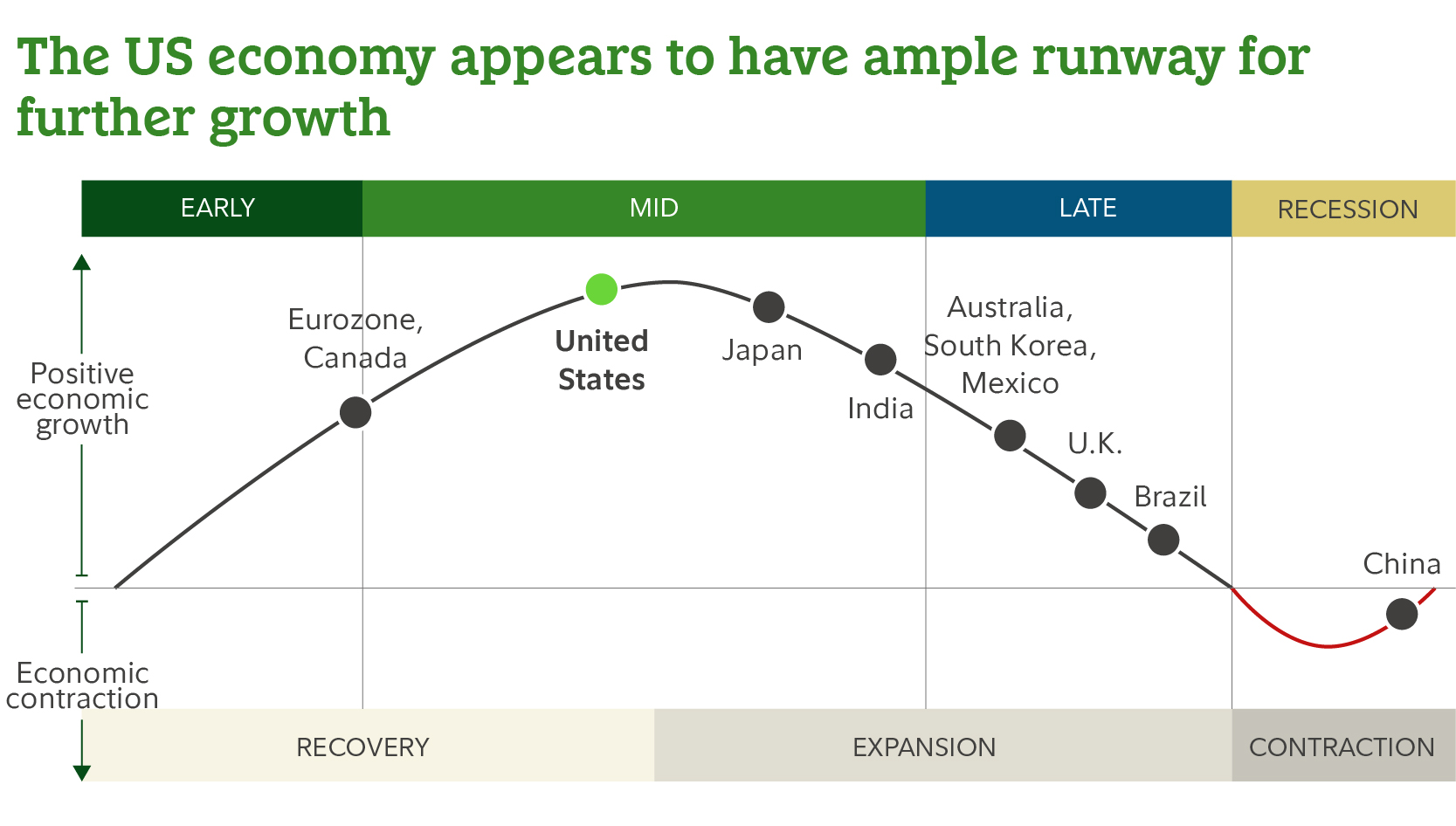
Much of the rest of the world shares this generally positive backdrop—albeit, like the US, with risks and news developments that often seem to overshadow this strength. “Much of the global economy remains in expansion and corporate earnings have been strong,” says Lars Schuster, institutional portfolio manager with Fidelity’s Strategic Advisers.
Some positive contributors to that backdrop may ebb or shift in the year ahead. Fiscal policy gave consumers and the economy a meaningful lift in 2026, including through tax and tariff refunds. But that boost is beginning to level off, while high government debt and rising interest costs may constrain policymakers’ ability to provide further stimulus. A year ago, investors broadly expected interest rates to fall further. Now, the question is how many more rate hikes may lie ahead.
How AI investment can support economic growth
One force that may continue to provide support is the AI buildout. According to some estimates, combined capital spending by 6 leading hyperscalers (companies that operate vast cloud-computing networks) could exceed $1.3 trillion in 2027. If realized, that would amount to nearly a tripling of annual investment from the $470 billion spent in 2025.
That could continue to fuel demand for all the products and services that have been buoyed by the buildout so far—from semiconductors and construction to power generation and transmission. But the sheer size of those investments also raises the stakes for important questions around how long such high investment growth rates can persist, and around overbuilding, overinvestment, and the timing and magnitude of payoffs on these investments.
Some investors may worry about an eventual peak in AI investment spending (i.e. CapEx), and whether such a reversal could bring down the broader economy. Denise Chisholm, director of quantitative market strategy at Fidelity, notes that history doesn’t necessarily support the worry.
“Historically, when technology CapEx slows from the kinds of levels we’ve been seeing, the rest of the economy has usually picked up,” Chisholm says. “It’s as though technology CapEx can be a leading indicator, and the rest of the economy follows after it.”
That handoff is hardly assured. But if that historical trend were to repeat in the current cycle, a moderation in technology investment could coincide with stronger growth elsewhere, carrying the expansion toward a broader and potentially more durable set of drivers.
2. AI remains the biggest swing factor
The direction of the AI story may be the biggest swing factor for 2027, not because the technology’s long-term transformative potential is in doubt, but because the road from infrastructure spending to profitable adoption could be long, and might include periods of overbuilding, financing stress, and reshuffling of winners and losers.
Lessons from past technology booms
Past technological transformations have rarely followed a straight line up and to the right. During the internet boom, for example, a “build it and they will come” philosophy fueled a networking buildout that produced, by some estimates, a 500-fold increase in capacity.1 Demand ultimately grew enormously, but not quickly or profitably enough to justify every investment, contributing to widespread company failures.2 The internet still transformed society and the economy, but on a different timeline and with a different set of winners than many investors initially expected.
“Every major technological wave, like the internet, the cloud, mobile phones, and railroads, delivered massive technological wins for the economy,” says Jurrien Timmer, Fidelity’s director of global macro. “But that doesn’t mean that the current companies building the picks and shovels will necessarily benefit from it.”
What happens if AI investment slows?
Demand for AI infrastructure appears to be strong and growing. But anecdotal reports of double or triple ordering suggest that some companies may be reserving more chips, power, or data-center capacity than they ultimately need, partly out of concern that failing to secure capacity could mean falling behind in the AI race. That makes it difficult to determine whether the current pipeline reflects enduring demand or some degree of overbuilding.
“Companies and investors are all asking the question right now of: Do we have enough AI capacity?” says Norimoto. “At this juncture, that is unanswerable.”
The good news is that investors are already asking difficult questions about spending levels, payoff timelines, long-term profitability, and financing. These concerns came to the fore in November 2026, as investors brought fresh scrutiny to the valuations of AI-related stocks and the sustainability of the investment boom—contributing to a sharp pullback in AI stocks. This kind of investor skepticism has helped to restrain price-earnings ratios (P/Es), reducing parallels to the dot-com bubble in stock prices.
But the interconnected nature of the AI ecosystem may create a risk that isolated problems, such as recent volatility in the market for AI-related high-yield bonds, could spread. Some companies are linked through what Timmer describes as “circular” financing arrangements involving supplier relationships, customer commitments, equity stakes, debt financing, and other agreements. Timmer says a downside “wild card” would be “contagion spreading from these little corners of the AI story into the greater ecosystem of AI.” He emphasizes this is not his base case.
Anu Gaggar, vice president of capital markets strategy with Fidelity Institutional, says a period of “consolidation or digestion” for the AI theme would not necessarily produce a sustained negative market outcome. “Even in that environment, markets could continue to perform well,” she says. “Leadership would simply look different.”
As the buildout matures, she expects opportunities to shift toward adoption: “Investors should spend less time trying to identify the next winner of the AI buildout and more time positioning for the next phase of the productivity cycle.” Businesses built on top of AI, what she calls “AI-native” companies, may become increasingly important.
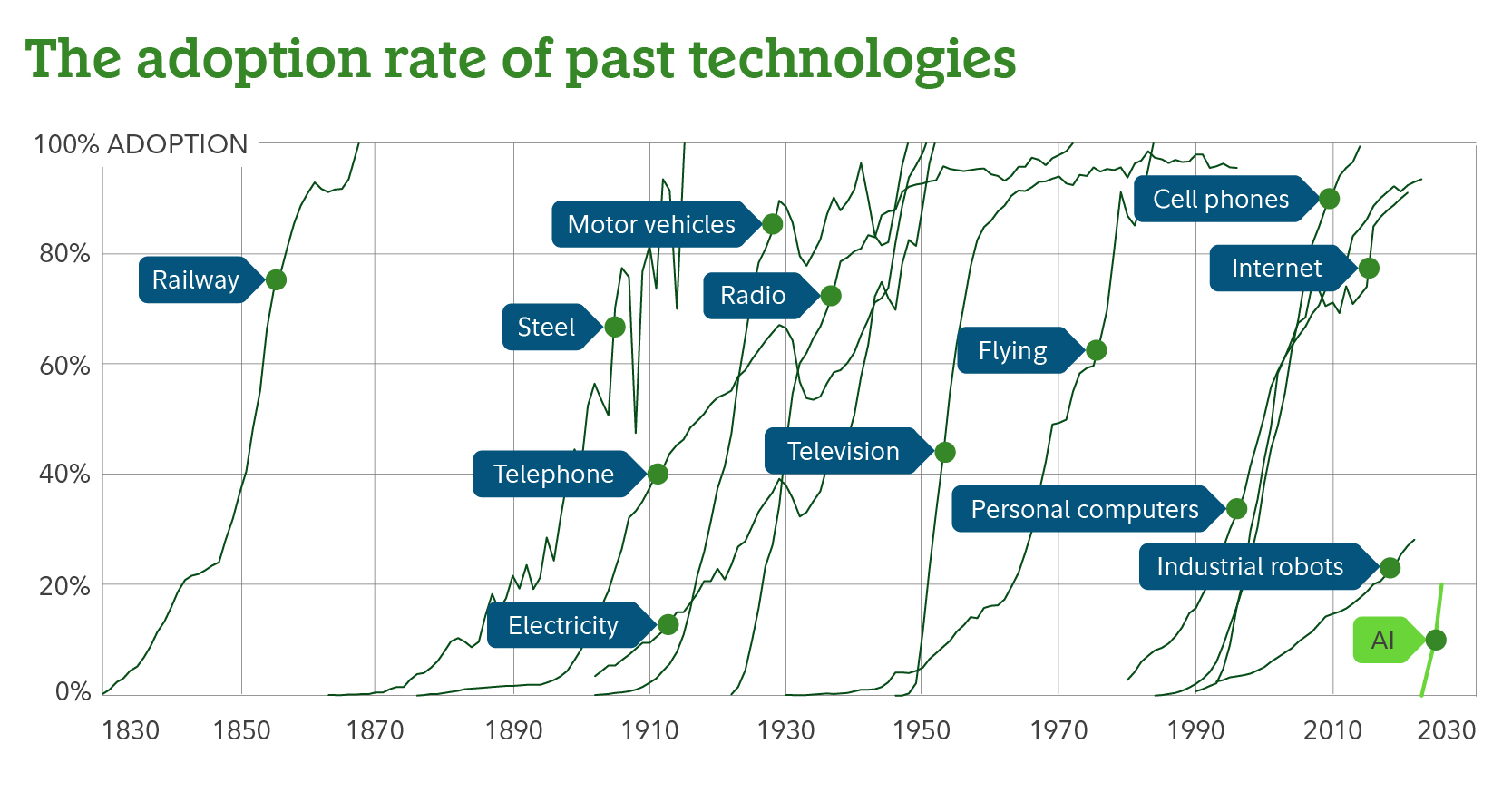
For 2027, then, the central question may not be whether the AI transformation continues. It may be whether the buildout progresses toward profitable adoption through an orderly period of consolidation and changing market leadership, or through a more disruptive reckoning with overcapacity and financing risk.
3. Earnings growth may slow while participation broadens
2026 may be remembered as a year of historic earnings growth. Profit margins touched their highest levels on record.3 Analysts expect profit growth for S&P 500 companies may end at 34% for 2026, buoyed by more than 50% expected growth in the technology sector.4
Those growth rates are unlikely to last through 2027. Consensus analyst estimates call for earnings growth for S&P companies to slow to about 16% in 2027.5 That would be a marked deceleration, but still a robust rate of growth.
“No one’s going to be shocked if earnings growth decelerates,” says Timmer. “And that’s fine. The market doesn’t have to decline when that happens.” Historically, he notes, markets have often been able to absorb a slowdown from extraordinary to merely healthy earnings growth when the economy avoids recession.
Moreover, there are tentative signs that the composition of that growth may be broadening. All 11 S&P 500 sectors reported or were reporting year-over-year profit gains in the third quarter.6 For the first time in about 4 years, non-Magnificent-7 companies were on track for a higher pace of earnings growth than the Magnificent 7.7
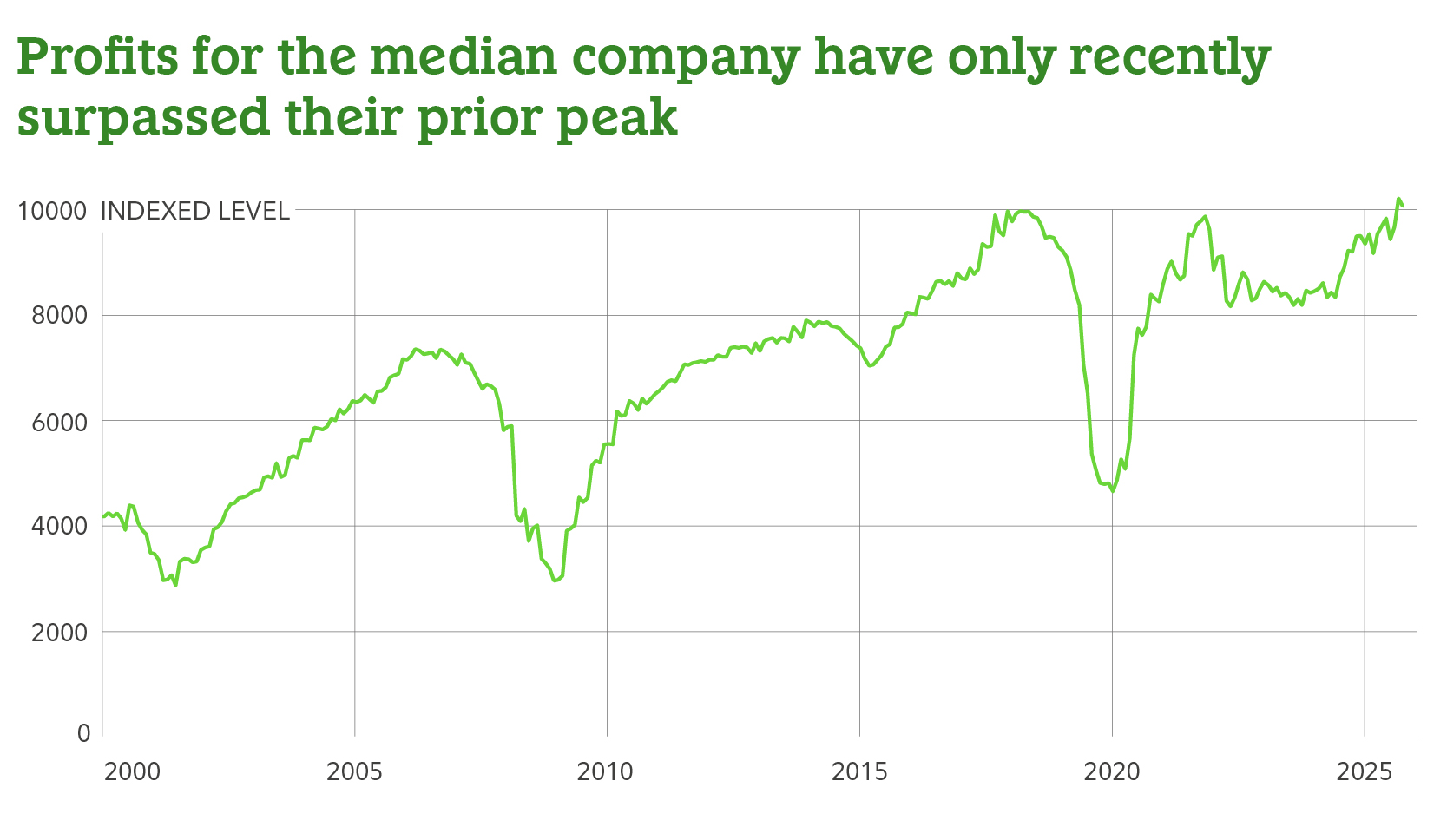
That could be an early sign of precisely the handoff Chisholm is watching for. Although profitability for major market indexes (which can be heavily influenced by a few big earners) has been exceptionally strong, it has generally not been broadly shared by companies across the economy. When focusing on median levels of profitability—which Chisholm tracks by looking at the largest 3,000 US stocks by market capitalization, and finding median profitability among those companies—earnings growth has looked much weaker. “For the median company, earnings peaked in 2018 and have only just been getting back to those prior peak levels,” she says.
4. Interest rates remain a risk, with energy as a wildcard
Rising interest rates were a key feature of the 2026 financial landscape, with yields on long-term Treasurys making headlines for hitting multi-decade highs. Timmer says that one of the biggest themes he’s watching for the year ahead is whether the US experiences more of these “rate scares.”
Interest rates can affect the stock market in several ways. Higher yields increase companies’ borrowing costs. As rates rise, bonds can become more attractive—giving investors more competitive alternatives to stocks. Higher rates can also put pressure on the P/E ratios investors are willing to pay for stocks, particularly for growth companies whose valuations depend on discounting profits expected far in the future.
Although stocks did experience some volatility from rising rates in 2026, exceptional earnings growth also helped to provide a cushion. Timmer notes that the S&P’s forward P/E ratio has fallen 27% over roughly the past year (forward P/E is price divided by consensus analyst earnings estimates for the next 12 months). Had earnings not risen, that decline could have translated into an equal decline in stocks. But with earnings growth expected to slow in 2027, the market may have less of a cushion if rates become volatile again.
Could energy prices drive inflation higher?
Energy could play an important—if unpredictable—role. Oil prices and stocks have become increasingly negatively correlated since the start of the Iran conflict, meaning that rising oil prices have generally coincided with falling stock prices. That relationship reflects the multiple ways an energy price spike can affect the outlook at once: Higher oil prices can reduce consumers’ discretionary income, raise costs for businesses, and fuel inflation. Higher inflation can both increase the likelihood of interest rate hikes from the Federal Reserve and increase the “inflation premium” investors demand for owning fixed-rate bonds—contributing to rising rates on short- and long-term bonds that puts downward pressure on stocks.
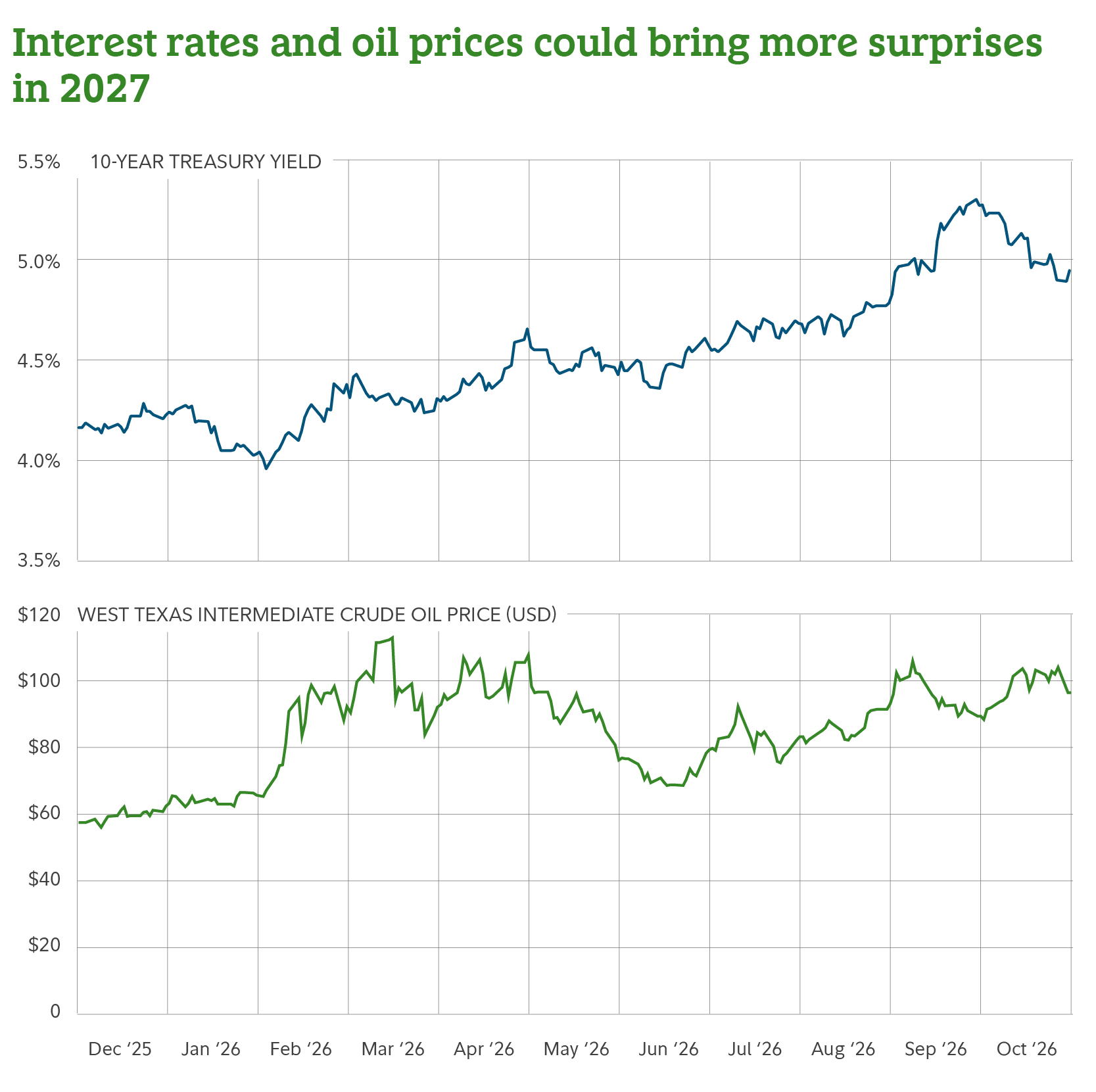
The potential for more energy-price volatility may have increased as buffers have been depleted. Norimoto notes that both the US and China have drawn down strategic petroleum reserves, but now have little room for further drawdowns. With thinner cushions, further energy-market disruption could produce a sharper market reaction. Meanwhile, the longer high energy prices drag on, the more they may begin to filter into broader inflation—as higher shipping and trucking costs influence the expense of transporting goods.
This kind of inflation can be challenging for the Fed to combat—the central bank has no sway over the global supply of oil, for example. But Aditi Balachandar, macro research analyst on Fidelity’s fixed income team, notes that the Fed’s actions can help to limit how broadly those price pressures filter through the economy.
She generally expects a “shallow tightening cycle” from the Fed, but adds that policymakers’ job may become more complicated in 2027. There are multiple crosscurrents facing the economy, including fading fiscal support and peaking growth and profits, even as a constrained labor supply keeps the job market tight and allows wage pressures, and inflation, to persist.
Why long-term interest rates could remain elevated in 2027
Longer-term interest rates are also influenced by forces outside the Fed’s control. “The size of the federal debt, and the interest costs associated with servicing that debt, are becoming increasingly important determinants of long-term Treasury yields,” says Gaggar.
That means 10- and 30-year Treasury yields could remain elevated even if the Fed raises short-term rates only modestly. Investors may demand greater compensation to absorb heavy government-debt issuance, persistent inflation risk, or both.
Together, these forces could send markets down very different paths in 2027. Easing geopolitical dynamics could reduce energy and transportation costs, cool inflation, and allow bond yields to fall, giving both earnings and stock valuations more room to rise. A renewed energy shock or mounting fiscal concerns could instead keep long-term rates elevated even if growth slows, pressuring profits and P/E ratios at the same time.
“As long as oil stays high, it puts a lid on how much bond yields can go down and therefore how much stocks can go up,” says Timmer.
5. A wider range of outcomes may mean a wider range of possible winners
The most likely path for 2027 may still be a constructive one: continued economic growth, slower but healthy earnings gains, and broader participation in the expansion. Timmer describes himself as “modestly bullish” for the year ahead, although he expects a more moderate year than investors have enjoyed in the recent past.
But today’s imbalances create meaningful risks in both directions. AI adoption could begin validating the enormous investment spending, while broader hiring and earnings growth could make the expansion more durable. Geopolitical de-escalation could lower energy costs, inflation, and interest rates, providing a fresh tailwind to stocks. Conversely, a disorderly retrenchment in the AI theme could spread through investment, credit, earnings, and stock prices. Because market wealth and discretionary spending are concentrated among higher-income households, a sustained market decline could also weaken consumer spending.
Of course, any year has its share of unknowns, pressures, and risks. And yet most years, historically, produce a market gain.
“The biggest risk for a stock investor is that you correctly identify the risks, and get the stock market reaction wrong,” says Chisholm. “Many investors focus so much on the headwinds that they forget the tailwinds.”
How investors can prepare for 2027
Investors may not need one perfect forecast or one investment capable of succeeding in every environment. With a complex year ahead, it may be more useful to prepare for multiple paths—seeking to build a portfolio with multiple drivers of return potential and resilience.
That might mean creating a broadly balanced portfolio, which includes exposure to plenty of growth potential, but also stocks that don’t depend on the AI theme. Relatively high yields mean there may be many opportunities to earn attractive income, but investors should also consider diversifying assets that may zig when stocks and bonds zag.
For 2027, investors could consider taking a page out of the book of veteran Fidelity portfolio manager Adam Kramer. “Instead of making predictions, I seek out a portfolio that could win if the economy does well or if the economy weakens,” he says. “I want to win in multiple scenarios.”