

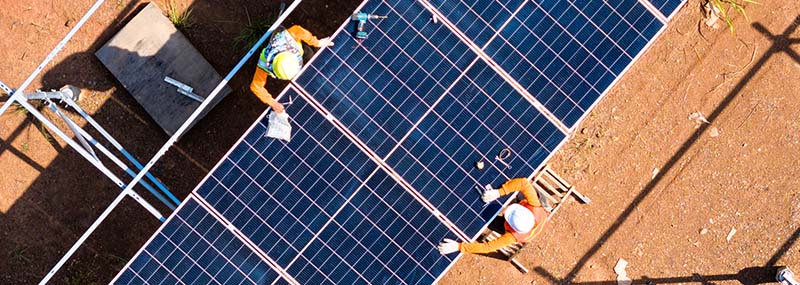
As countries invest billions in domestic energy infrastructure to strengthen energy security and help reduce emissions amid elevated geopolitical uncertainty, Fidelity Portfolio Manager Preeti Sayana says she sees opportunities in companies that provide infrastructure for renewable energy and power-grid modernization.
“The build-out of domestic renewable capacity in solar, wind and nuclear, alongside grid modernization and storage, can reduce a country’s exposure to external risk factors while simultaneously cutting emissions, presenting what I consider compelling investment opportunities,“ explains Sayana, who co-manages Fidelity® Climate Action Fund (FCAEX) with Asher Anolic.
In leading the thematic equity strategy, the managers focus on companies they believe are helping address climate change or its impact, either indirectly through their corporate strategy or directly through the technologies, services and products they provide.
Events such as Russia’s invasion of Ukraine, heightened competition between the U.S. and China regarding control of critical minerals and rare earths, and, more recently, tensions involving the Strait of Hormuz have highlighted the urgency of domestic energy independence as a national security imperative, according to Sayana.
Learn More
Given these dynamics, she is focused on climate-related businesses that she believes could benefit from significant infrastructure investment. For example, Europe has committed more than $1 trillion toward upgrading its electricity grid and reducing reliance on imported fossil fuels, while directing additional funding toward grid infrastructure, nuclear technology and domestically produced clean energy.
“In addition to making infrastructure investments, the U.S., China and other nations are using public policy tools, including tax credits, subsidies, deregulation and trade measures, to pursue their own approaches to energy independence,” says Sayana.
To potentially capitalize on this trend, the fund has invested in companies involved in renewable energy, including First Solar (FSLR), Vestas Wind Systems (VWDRY) and Ceres Power Holdings (CPWHF). It also counts Centrus Energy (LEU) and Cameco (CCJ), both major players in nuclear energy, among its holdings as of September 30, 2026.
“I plan to continue monitoring global policies and trends as countries pursue energy independence, seeking opportunities that align with the portfolio’s investment mandate,” Sayana concludes.
For specific fund information, including full holdings, please click on the fund trading symbol above.

Preeti Sayana is a portfolio manager and research analyst in the Equity division at Fidelity Investments.
In this role, Ms. Sayana is responsible for researching international small cap companies. She is also the portfolio manager of Fidelity Series International Small Cap Fund and manages Sustainable U.S. Equity and Women’s Leadership strategies across various investment vehicles.
Prior to assuming her current responsibilities, Ms. Sayana was an analyst researching international small cap consumer companies focused on the Europe, Japan, and Australia markets. She was also on the emerging markets and core research teams for 12 years. She covered emerging-market consumer companies globally and focused on U.S. large cap consumer stocks. Additionally, she worked as the small and mid cap generalist for India.
Before joining Fidelity in 2005, Ms. Sayana was, from 1998 to 2005, an analyst at Putnam Investments, where she held various research roles in the consumer, telecom, and technology sectors. She has been in the financial industry since 1993.
Ms. Sayana earned her Bachelor of Commerce from Osmania University, her Master of Business Administration in finance from the University of Massachusetts, and her Master of Science in finance from Boston College. She also is a CFA® charterholder.