No annual account fees or minimums
There's no minimum and no account fees to open a Fidelity-managed 529 account.

Tax-smart savings
Any earnings grow federal income tax deferred, plus get tax-free withdrawals for qualified education expenses.

Flexible use of funds
Pay for college, trade school, and K–12 nationwide, including tuition, fees, and books.1
U.Fund plan information

The U.Fund College Investing Plan received Morningstar's Gold Rating for the second year in a row2
Account overall max:
$500,000 maximum balance per beneficiary3
State tax deduction:
MA residents are eligible for up to $1,000 individual, $2,000 married couple
Earnings:
Any earnings grow federal and Massachusetts income tax–deferred.
Withdrawals:
Qualified withdrawals are free from both federal income tax and Massachusetts income taxes
College savings incentive programs:
BabySteps, a program designed to encourage saving for college, provides a $50 seed deposit into a U.Fund account for any child who is a MA resident and is born or adopted on or after January 1, 2020 (within one year of the birth or adoption).
NextSteps, a college savings incentive program sponsored by MEFA. The program provides for a one-time $50 matching contribution to an individual U.Fund Plan Account opened on or after January 1, 2026 for a child aged no less than one year old and no more than three years old, that are a Massachusetts resident. Visit the NextSteps Plan rules (PDF) for more information
Plan performance and application:
Download the annual report (PDF)
Access the plan application & fact kit
Investing in your 529
When you open your 529 account, you’ll choose from among different investment portfolios. You can change the asset allocation twice each calendar year, or if you change the beneficiary of your 529 account.
The MA plan offers 3 types of portfolios: age-based, static, and individual. You can allocate money among these investment portfolios, in 5% increments that total 100%. Before you open your account, think about what you might want to invest in.
An age-based portfolio may be right for you if you want a professionally managed portfolio that adjusts the asset allocation based on your beneficiary’s age—shifting to more conservative investments as college gets closer.
Fidelity Funds are actively managed mutual funds that attempt to beat the market, for investors with higher risk tolerance. Fidelity Index Funds are low-cost index mutual funds that closely mirror the market, for investors with lower risk tolerance. Fidelity Blend Funds incorporate both, for investors with moderate risk tolerance.
View information on the portfolios’ short-term performance, or average annual total returns by month or by quarter. Please review the 529 plan Fact Kit (PDF) for more detailed information.
A static portfolio may be right for you if you want a diversified portfolio, with an asset allocation that stays constant over time. You'll get a combination of equity, fixed income, and short-term investments.
Fidelity Funds are actively managed mutual funds that attempt to beat the market, for investors with higher risk tolerance. Fidelity Index Funds are low-cost index mutual funds that closely mirror the market, for investors with lower risk tolerance.
MA Aggressive Growth Portfolio
Funds | Index
MA Moderate Growth Portfolio
Funds | Index
View information on the portfolios’ short-term performance, or average annual total returns by month or by quarter. Please review the 529 plan Fact Kit (PDF) for more detailed information.
Individual investing may be right for you if you want greater flexibility over your investment strategy. Each portfolio contains holdings all from one asset class, like equity, fixed income, short-term investments, and bank deposit options. You decide how to allocate your money in 5% increments.
View information on the portfolios’ short-term performance, or average annual total returns by month or by quarter. Please review the 529 plan Fact Kit (PDF) for more detailed information.
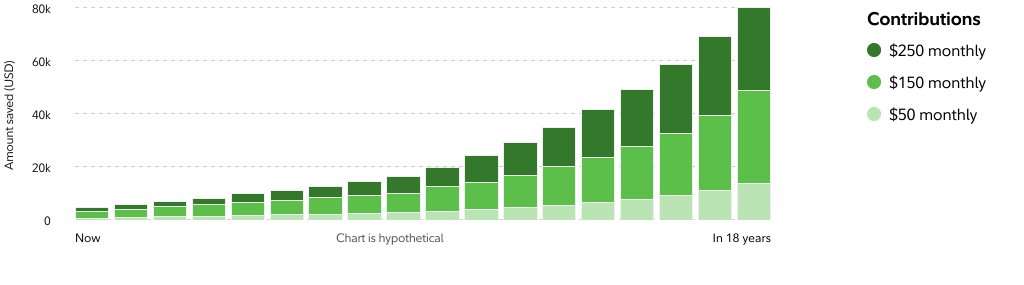
Saving a little over time can go a long way
Recurring contributions can potentially help your money grow—and reduce the amount of student loans borrowed.*
Learn

Explore the latest ways to save and pay for a child’s education with a 529 plan
Learn how a 529 can help you reach your educational savings goals at any stage of your journey.
Video (30:10)


529 plans: The tax-smart way to help save for college
The money moves to help you reach your education goals.
Podcast (18:33)

The ABCs of 529 savings plans
Learn ways to explore investment options and potential tax advantages.
Article

Frequently asked questions
Should I open a 529 account offered by the state I live in, or another state?
You can open a 529 account offered by any state. Be sure to consider your own state’s plan as it may have additional benefits, including state tax advantages. No matter what state your child will attend school in, you can use a 529 account to pay for qualified education expenses at eligible institutions nationwide.
What if my child doesn’t go to college, or there’s money left in the 529 account after they graduate?
You have a few options. You can change the 529 account beneficiary to an eligible family member for their qualified education expenses. Or, you may be eligible to transfer assets from the 529 to a Roth IRA in the beneficiary’s name.6 Finally, you can take a non-qualified withdrawal. Only the portion of the non-qualified withdrawal attributed to investment earnings will be subject to federal and state income taxes, plus a 10% federal penalty.
About MEFA
Who is MEFA?
MEFA is a state administrator working with Fidelity Investments to offer the U.Fund. A state authority established in 1982 by the Massachusetts Legislature, MEFA's mission since its founding has been to help students and families access and afford higher education and reach financial goals through education programs, tax-advantaged savings plans, competitive-rate loans, and expert guidance. All of MEFA's work aligns with their goal to support the independence, growth, and success of students and families. For more information on MEFA, visit mefa.org/about
MEFA education loans
MEFA offers competitive, fixed interest rate loans to help families pay for college, as well as an education refinancing loans designed to lower the monthly payment and interest rate for individuals repaying education loans.
College planning guidance
MEFA's free guidance is available to families in every phase of college planning and includes emails, articles, videos, a podcast, seminars, webinars, calculators, and timelines. Visit mefa.org to access all resources.
Contact us

Contact us
800-544-2776

618038.45.1