
How can I make my retirement savings last?
Withdraw only 4% to 5% from savings yearly, with adjustments for inflation.
Article  9 min
9 min
 Article 9 min
 After years of saving, spending your retirement money can feel like a big change. Fidelity can help you align to a plan that provides income while still keeping part of your savings growing.

As you begin using your retirement savings, your investment strategy should help you cover anything from daily expenses to unexpected emergencies, while still leaving room for growth. Here are some common investments to help support you.
Most people will need to replace 55%–80%1 of their preretirement income. These investments seek to provide a payout which can help you manage inflation.
Most people will need to replace 55%–80%1 of their preretirement income. These investments seek to provide a payout which can help you manage inflation.
Help stabilize your portfolio from stock market volatility with a collection of bonds traded intraday.
Choose from new issue and secondary bonds and brokered CDs, with more than 150,000 offerings to fit your portfolio.

Social Security typically replaces 5%–35%2 of the income you had preretirement. Annuities can help fill the gap with guaranteed income to cover expenses.
Social Security typically replaces 5%–35%2 of the income you had preretirement. Annuities can help fill the gap with guaranteed income to cover expenses.
Create a predictable stream of income for a set period of time with payouts that can start within a year.4
Estimate your Social Security benefits at different ages to help you choose when to claim.

Even in retirement, an investment strategy focused on protecting and responsibly growing your wealth can help you make your savings last.
Even in retirement, an investment strategy focused on protecting and responsibly growing your wealth can help you make your savings last.
Access professionally managed funds that invest in stocks, bonds, or other assets to help support your goals.
Invest in a fund that becomes more conservative over time until your specified date.

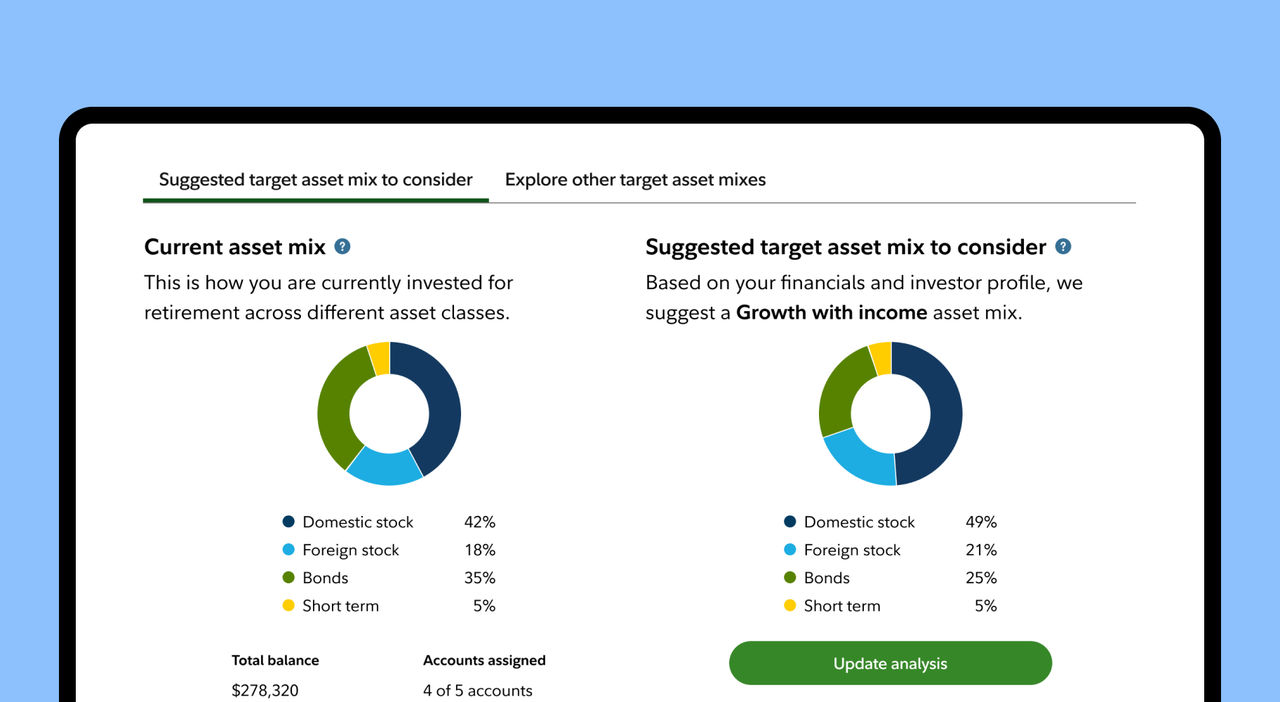
Get an analysis of your asset mix and explore changes that could improve your retirement outlook.
Loading
Loading may take a few moments.
How much you withdraw, especially early in retirement, can have a dramatic impact on how long your money may last. Learn more about the sequence-of-returns risk in this video.
You've built an investing plan for your retirement tailored to your goals, timeline, and comfort with risk. We're here to help you make sure you're on track.
Withdraw only 4% to 5% from savings yearly, with adjustments for inflation.
9 min 
How to balance income and growth as retirement approaches.
12 min 1. Fidelity Financial Solutions, 2019. Calculations are based on a set of income replacement targets for estimating the retirement income need. These income replacement targets in turn are based on Consumer Expenditure Survey (BLS), Statistics of Income Tax Stat, IRS tax brackets and Social Security Benefit Calculators. The national spending data was analyzed across a salary range of $50,000-$300,000, therefore this calculator may have limited applicability if income is outside that range.
2. Fidelity has developed a series of income multiplier targets corresponding to different ages, assuming a retirement age of 67, a 15% savings rate, a 1.5% constant real wage growth, a planning age through 93, and an income replacement target of 45% of preretirement income (assumes no pension income). The final income multiplier is calculated to be 10x your preretirement income and assumes a retirement age of 67. The income replacement target is based on Consumer Expenditure Survey (BLS), Statistics of Income Tax Stat, IRS tax brackets and Social Security Benefit Calculators. The 45% income replacement target (excluding Social Security and assuming no pension income) from retirement savings was found to be fairly consistent across a salary range of $50,000-$300,000, therefore this factor may have limited applicability if your income is outside that range. The 45% income replacement target assumes a retirement and Social Security claiming age of 67, which is the full Social Security benefit age for those born in 1960 or later. For an earlier retirement and claiming age, this target goes up due to lower Social Security retirement benefits. Similarly, the target goes down for a later retirement age. For a retirement age of 65, this target is defined as 50% of preretirement annual income, and for a retirement age of 70, this target is defined as 40% of preretirement income. As the income multiplier target is based on income replacement target and retirement age, for an earlier retirement age, this target goes up due to lower social security retirement benefits and a longer retirement horizon. Similarly, the target goes down for a later retirement age. For a retirement age of 65, this target is defined as 12x and for a retirement age of 70, this target is defined as 8x.
3. Deferred Income Annuity contracts are irrevocable, have no cash surrender value and no withdrawals are permitted prior to the income start date.
4. In order to provide an income stream, there is no or limited access to assets.
Annuity guarantees are subject to the claims-paying ability of the issuing insurance company.
In general, the bond market is volatile, and fixed income securities carry interest rate risk. (As interest rates rise, bond prices usually fall, and vice versa. This effect is usually more pronounced for longer-term securities.) Fixed income securities also carry inflation risk, liquidity risk, call risk, and credit and default risks for both issuers and counterparties. Unlike individual bonds, most bond funds do not have a maturity date, so holding them until maturity to avoid losses caused by price volatility is not possible. Any fixed income security sold or redeemed prior to maturity may be subject to loss.
Any fixed income security sold or redeemed prior to maturity may be subject to a substantial gain or loss. Your ability to sell a CD on the secondary market is subject to market conditions. If your CD has a step rate, the interest rate of your CD may be higher or lower than prevailing market rates. The initial rate on a step rate CD is not the yield to maturity. If your CD has a call provision, which many step rate CDs do, please be aware the decision to call the CD is at the issuer's sole discretion. Also, if the issuer calls the CD, you may be confronted with a less favorable interest rate at which to reinvest your funds. Fidelity makes no judgment as to the credit worthiness of the issuing institution.
Target Date Funds are an asset mix of stocks, bonds and other investments that automatically becomes more conservative as the fund approaches its target retirement date and beyond. Principal invested is not guaranteed.
IMPORTANT: The projections or other information generated by the Planning & Guidance Center's Retirement Analysis regarding the likelihood of various investment outcomes are hypothetical in nature, do not reflect actual investment results, and are not guarantees of future results. Your results may vary with each use and over time.
Diversification and asset allocation do not ensure a profit or guarantee against loss.
As with all your investments through Fidelity, you must make your own determination whether an investment in any particular security or securities is consistent with your investment objectives, risk tolerance, financial situation, and your evaluation of the security. Be sure to review your decisions periodically to make sure they are still consistent with your goals.
"Fidelity Managed Accounts" and "Fidelity managed accounts" refer to the advisory services provided for a fee through Strategic Advisers LLC (Strategic Advisers), a registered investment adviser. Brokerage services are provided by Fidelity Brokerage Services LLC (FBS), and custodial and related services are provided by National Financial Services LLC (NFS), each a member of NYSE and SIPC. Strategic Advisers, FBS, and NFS are Fidelity Investments companies.
Fidelity advisors are licensed with Strategic Advisers LLC (Strategic Advisers), a registered investment adviser, and registered with Fidelity Brokerage Services LLC (FBS), a registered broker-dealer. Whether a Fidelity advisor provides advisory services through Strategic Advisers for a fee or brokerage services through FBS will depend on the products and services you choose.
Fidelity does not provide legal or tax advice. The information herein is general and educational in nature and should not be considered legal or tax advice. Tax laws and regulations are complex and subject to change, which can materially impact investment results. Fidelity cannot guarantee that the information herein is accurate, complete, or timely. Fidelity makes no warranties with regard to such information or results obtained by its use, and disclaims any liability arising out of your use of, or any tax position taken in reliance on, such information. Consult an attorney or tax professional regarding your specific situation.
The images, graphs, tools, and videos are for illustrative purposes only.
Before investing, consider the investment objectives, risks, charges, and expenses of the fund or annuity and its investment options. Contact Fidelity for a prospectus or, if available, a summary prospectus containing this information. Read it carefully.
Fidelity and Fidelity Viewpoints are registered service marks of FMR LLC.
Fidelity Brokerage Services LLC, Member NYSE, SIPC, 900 Salem Street, Smithfield, RI 02917
© 2026 FMR LLC. All rights reserved.
1268976.1.1