
3 reasons to contribute to an IRA
Saving in an IRA comes with tax benefits that can help grow your money.
Article  7 min
7 min
 Article 7 min
 Making consistent contributions—and then putting your money to work by investing your IRA—can give your savings the chance to grow with tax advantages; find out the income and contribution limits that apply to you.

Your income determines whether you can contribute to a Roth IRA or deduct traditional IRA contributions.
Contributing is just the first step—investing is what gives your money the potential to grow over time.
Set up recurring contributions and investments so your progress stays on track—without having to think about it.
Income requirements
You or your spouse must have earned income to contribute to an IRA. However, you cannot contribute more than you make.
Age requirements
You can contribute to an IRA at any age. Whether you have a traditional IRA, a Roth IRA―or both―the maximum combined amount you may contribute annually across all your IRAs is the same:
2026
The deadline for 2026 contributions to Roth or traditional IRAs is April 15, 2027.
| Filing status | Modified adjusted gross income | Contribution limit |
|---|---|---|
| Single individuals | < $150,000 | $7,500 if under age 50 $8,600 if age 50 or older |
| ≥ $150,000 but < $165,000 | Partial contribution (calculate) | |
| ≥ $165,000 | Not eligible | |
| Married (filing joint returns) | < $242,000 | $7,500 if under age 50 $8,600 if age 50 or older |
| ≥ $242,000 but < $252,000 | Partial contribution (calculate) | |
| ≥ $252,000 | Not eligible | |
| Married (filing separately)* | Not eligible | $7,500 if under age 50 $8,600 if age 50 or older |
| < $10,000 | Partial contribution (calculate) | |
| ≥ $10,000 | Not eligible |
| Filing status | Modified adjusted gross income | Deduction limit |
|---|---|---|
| Single individuals | ≤ $81,000 | Full deduction up to the amount of your contribution limit ($7,500 if under age 50 or $8,600 if age 50 or older) |
| > $81,000 but < $91,000 | Partial deduction (calculate) | |
| ≥ $91,000 | No deduction | |
| Married (filing joint returns) | ≤ $129,000 | Full deduction up to the amount of your contribution limit ($7,500 if under age 50 or $8,600 if age 50 or older) |
| > $129,000 but < $149,000 | Partial deduction (calculate) | |
| ≥ $149,000 | No deduction | |
| Married (filing separately)* | Not eligible | Full deduction up to the amount of your contribution limit ($7,500 if under age 50 or $8,600 if age 50 or older) |
| < $10,000 | Partial deduction (calculate) | |
| ≥ $10,000 | No deduction |
| Filing status | Modified adjusted gross income | Deduction limit |
|---|---|---|
| Single, head of household, qualifying widow(er), or married (filing jointly with a spouse who is not covered by a plan at work) |
Any amount | Full deduction up to the amount of your contribution limit ($7,500 if under age 50 or $8,600 if age 50 or older) |
| Married (filing jointly with a spouse who is covered by a plan at work) | $242,000 or less | Full deduction up to the amount of your contribution limit ($7,500 if under age 50 or $8,600 if age 50 or older) |
| > $242,000 but < $252,000 | Partial deduction (calculate) | |
| ≥ $252,000 or more | Not eligible | |
| Married (filing separately)* | < $10,000 | Partial deduction |
| ≥ $10,000 | No deduction |
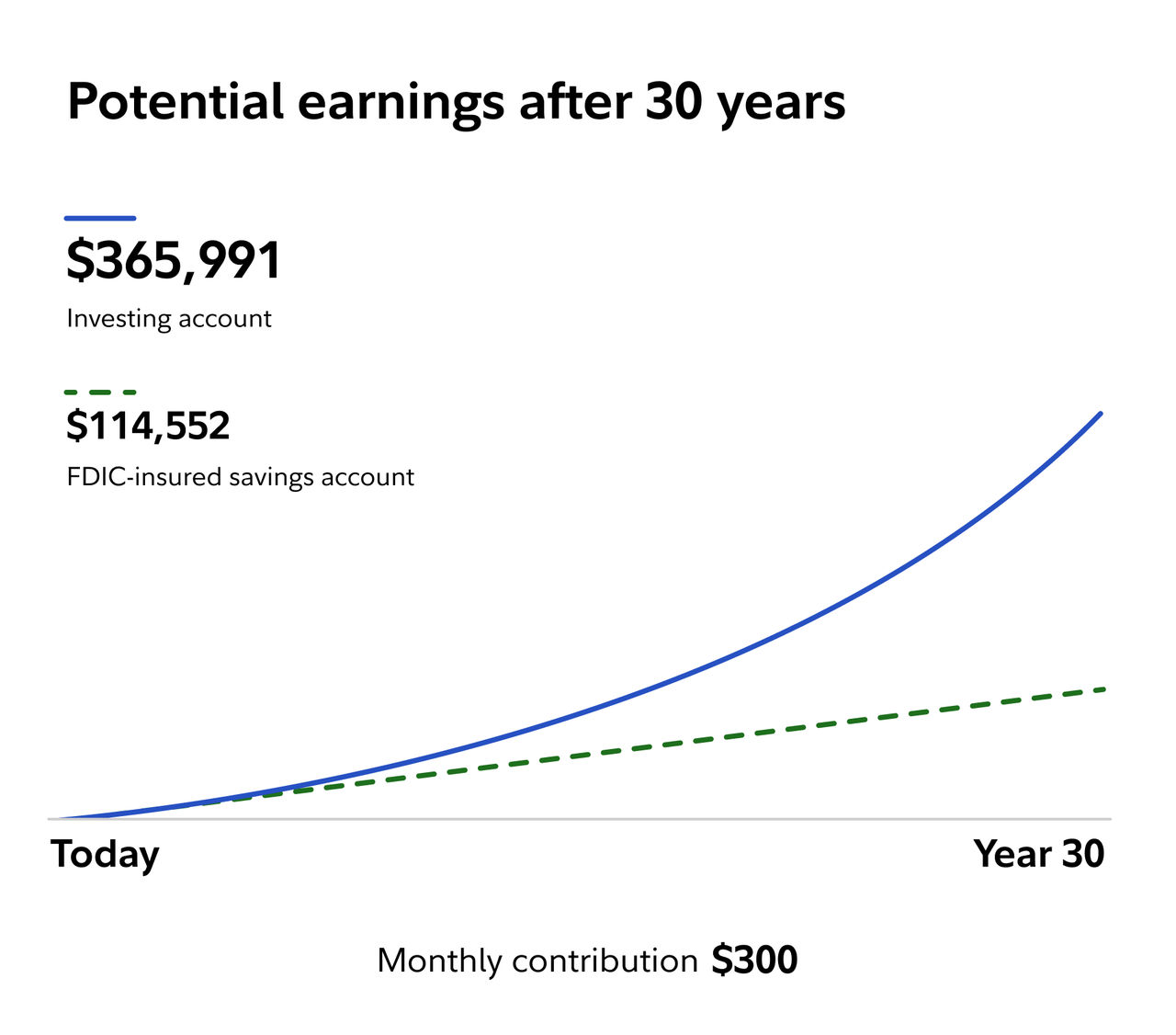
This chart is a hypothetical comparison. Investing involves risk of loss, and performance is not guaranteed. How we got these numbers.
This chart shows an example of how contributing $300 monthly for 30 years could result in $365,991 if invested, compared to $114,552 if left in a FDIC-insured savings account.
This chart is a hypothetical comparison. Investing involves risk of loss, and performance is not guaranteed. How we got these numbers.
If you have a Fidelity IRA, you can make a one-time contribution, or make it simple with recurring contributions and investments.
Saving in an IRA comes with tax benefits that can help grow your money.
7 min 
This step can be overlooked by even the savviest investors.
4 min 
Get details on SEP IRA, SIMPLE IRA, and self-employed 401(k) contributions—and more.

Switch a traditional IRA contribution to a Roth IRA contribution (or vice versa) or correct an excess IRA contribution—we’ll walk you through it.
We can help you find the answers.
Keep in mind that investing involves risk. The value of your investment will fluctuate over time, and you may gain or lose money.
* Married (filing separately) can use the limits for single individuals if they have not lived with their spouse in the past year.
Fidelity does not provide legal or tax advice. The information herein is general and educational in nature and should not be considered legal or tax advice. Tax laws and regulations are complex and subject to change, which can materially impact investment results. Fidelity cannot guarantee that the information herein is accurate, complete, or timely. Fidelity makes no warranties with regard to such information or results obtained by its use, and disclaims any liability arising out of your use of, or any tax position taken in reliance on, such information. Consult an attorney or tax professional regarding your specific situation.
Fidelity Brokerage Services LLC, Member NYSE, SIPC, 900 Salem Street, Smithfield, RI 02917
1274403.1.0