Invest for your goals today and after graduation
Your university has teamed up with Fidelity, a financial services company, to help you take the next step in your financial journey. Learn how the Fidelity Investments® app can help.
Get help investing in your future
- Guided starter paths help you start and stay on track
- In-app lessons teach you how to save and invest
- Invest with as little as $1—no account fees or minimums to open1
Investing early could give you a head start
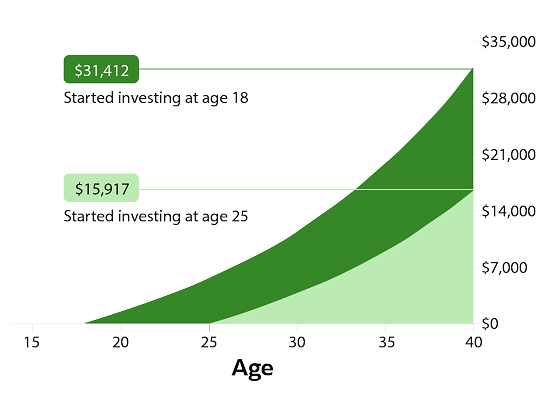
Chart is a hypothetical comparison and is for illustrative purposes only. Investing involves risk of loss and performance is not guaranteed. How we got these numbers.2
A first-year college student who invested less than $2/day ($600/year), and earned a 7% annual return, could have almost twice as much money at age 40 vs. if they waited until age 25 to invest.
Check out our money tips for college students
How to get started
-
Download the Fidelity Investments® app
Get the app to access your school’s customized experience.
-
Open your account
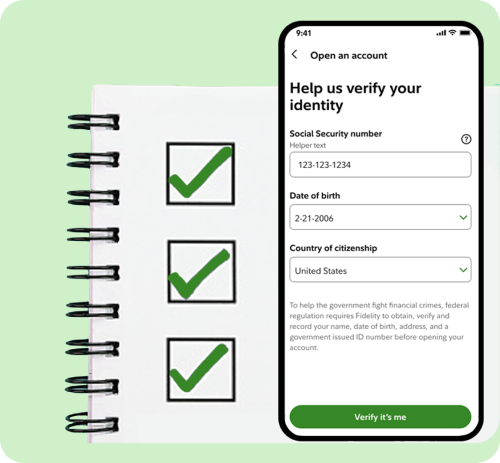
Provide some required details, including your Social Security number. Then create a login and agree to the terms.
-
Add money and invest
Link a bank, and transfer money into your account. Then you’re ready to start investing.
Explore lessons on financial basics
Not sure where to start? Visit the Discover tab to learn the basics of saving and investing with our quick, bite-sized lessons.
Within minutes, you can learn to:
- Save for your goals
- Boost your credit and use credit cards wisely
- Measure your risk tolerance and pick investments
Overview
-
What is the Fidelity app?
The Fidelity app is designed to help you learn how to navigate finances, track your financial progress, and get started investing with starter paths.
-
How does the Fidelity app work?
The Fidelity app helps you stress less and learn how to navigate finances with in-app learning, live education events on campus, and digital resources.
-
How do I ensure that my school affiliation is linked to my account?
Log in to the app, visit Profile & Settings, select App, then go to Link School. You can also scan your school's QR code before logging in.
-
What type of account am I opening with Fidelity?
You are opening a brokerage account.
A brokerage account gives you access to the stock market and other investment options such as bonds, ETFs, and mutual funds to buy and sell based on your goals and time horizon.
-
How can I download my university's customized Fidelity app experience?
The only way to download the Fidelity app is to scan your university's unique QR code. You can find this on your Fidelity information card, your university's website, or campus signage.
If you can't find these materials, please call us at 800-343-3548.
-
Where can I find my university's unique QR code to download the Fidelity app?
You can find your university's unique QR code on your Fidelity information card, your university's website, or campus signage. If you can't find these materials, please call us at 800-343-3548.
-
What happens to my Fidelity account when I leave or graduate from college?
Your Fidelity account is yours. When you leave or graduate from your university, the account remains yours. You can still access your account through the Fidelity app and Fidelity.com.
Opening your account
-
What do I need to open my account with Fidelity?
To open your account, you'll need to provide your phone number, Social Security number, government-issued ID, and a personal email address. Fidelity does not recommend providing your university email address as you may lose access to it after graduation.
-
How much money do I need to deposit to get started?
You don't need to make any deposits when you open your account to get started.
-
What should I do if my identity cannot be verified in the Fidelity app?
In some cases, extra steps will be necessary to verify your identity before you can open your Fidelity account.
You may see a message in the app or receive an email asking you to upload additional documents. If you see this message or receive an email, you will need to upload a photo of your Social Security card and your government-issued ID (like a driver's license or passport).
-
The app says I have a Fidelity account, but I don’t know my login credentials. How do I recover my login credentials?
It's possible that you opened a Fidelity retirement account—like a 401(k)—as part of your benefits package through a current or previous employer.
If you don't know your login credentials, you'll first need to look up your username and reset your password through Fidelity.com.
To look up your username or reset your password, follow these steps:
Go to Fidelity.com and select "Log in."
Select "Forgot username or password?"
Verify your identity by entering your name, date of birth, and the last 4 digits of your Social Security number, then select "Continue."
When asked to request a security code, select the phone number where you want the code sent.
Select "Lookup username" or "Reset password" and follow the prompts.
If you're asked a security question, answer it and you'll be prompted to create a new password.
If you answer incorrectly, Fidelity will block access to your account until we can verify no one else is trying to access it.
To unblock your account, please call 800-343-3548.
Once you know your username and reset your password, you can open your account using these credentials.
Customize your Fidelity app
-
How do I customize my account view?
From Home, select an account, then select the 3 dots at the upper right of the screen. From that menu, select "Account screen layout," then select either "Single screen" or "Tabs."
-
How can I customize a Watch List?
From Home, select "Investing," select "Watch Lists," then select "Manage" to edit or manage a Watch List, or to add new ticker symbols.
-
Can I set up recurring investments?
Yes, you can set the amount, frequency, and payment timing of recurring investments from the app. They can be paid either from your Fidelity core position or from your linked bank account. And you can always modify or cancel if anything changes.
-
Where can I explore and research investments and stocks?
Select "Discover" and scroll down to see different types of research information and investment ideas.
-
How do I find alerts, messages, and notifications?
If you have an alert, message, or notification, you'll see a green dot on the profile icon in the upper right of Home. To view them, select the icon, then scroll down to Communication and select Alerts.
Start investing
-
What is investing?
Investing is when you buy something in the hopes that it’ll appreciate (aka increase in value). People can invest in many ways, but in the financial world, investing most often refers to buying an asset, like a mutual fund, that you expect will help you grow your money over time. Investing is a way to make your money work for you—and give it a chance to potentially grow more than it could if it were sitting in a savings account.
Keep in mind that there are no guarantees with investing.
-
How much money do I need to start investing with the Fidelity app?
You can start investing in the Fidelity app with as little as $1. The Fidelity app offers starter paths to help guide you and track your progress. Plus, enjoy no account fees and no account minimums to open.1
-
Where is my money held before I invest it?
When you deposit money into your Fidelity brokerage account, it is placed in a low-risk money market mutual fund that enables it to earn returns. The fund is referred to as your "core position."
You could lose money by investing in a money market fund. Although the fund seeks to preserve the value of your investment at $1.00 per share, it cannot guarantee it will do so. The fund may impose a fee upon the sale of your shares. An investment in the fund is not a bank account and is not insured or guaranteed by the Federal Deposit Insurance Corporation or any other government agency. Fidelity Investments and its affiliates, the fund’s sponsor, is not required to reimburse the fund for losses, and you should not expect that the sponsor will provide financial support to the fund at any time, including during periods of market stress.
-
How do I place a trade?
Step 1: Search for a stock, mutual fund or ETF.
Step 2: Tap "Buy" or "Sell."
Step 3: Choose an order type.
Step 4: Type in a dollar amount or a number of shares and select "Review."
Step 5: Slide to trade.
For additional support, please use the Fidelity Assistant.
-
What are different ways I can invest?
Stocks
Stocks are probably what you hear about most often when people talk about the "market." They allow you to invest in a company and each piece of ownership is known as a "share." Each share is worth a certain dollar amount that changes throughout the day as stocks are bought or sold in real time on stock exchanges. You can also buy a "fractional share" or a small slice of a company's stock rather than the whole share. This can make it easier to start investing since the stock for some companies can trade for hundreds or even thousands of dollars per share.Mutual Funds
Think of mutual funds as an investment stew. Investments, such as stocks, bonds, and other ingredients are mixed together (some funds may invest only in stocks or only in bonds) and sold as 1 dish, creating a mutual fund. They offer a way to buy different investments packaged together, or served together like a "dish," and sold together as 1 entity instead of as individual companies. Investments in mutual funds change all the time, as they are managed by a team of professionals who decide which investments to buy and sell. They often come with additional fees (some low, some high) that stocks don't have because professional managers are making the investment selections. The price of a mutual fund is updated at the end of each business day. You can find out more about each fund's objective and strategies in its prospectus.Exchange-Traded Funds (ETFs)
ETFs (exchange-traded funds) are another sort of investment stew that mixes together stocks and/or bonds, and sells them for 1 price. They often try to mimic a major stock index, like the S&P 500®, which represents the 500 largest companies in the United States. Because you can't buy from the S&P 500® directly, and may not want to buy stock in each individual company, you can buy 1 ETF "unit" or "share" and invest in all these companies at once, trading in real time like stocks.
Investing involves risk, including risk of loss.
1.
Zero account minimums and zero account fees apply to retail brokerage accounts only. Expenses charged by investments (e.g., funds, managed accounts, and certain HSAs) and commissions, interest charges, or other expenses for transactions may still apply. See Fidelity.com/commissions for further details.
2. Contributions of $1.64 ($600/365) per day, with daily compounding from 18 to 40, as well as from 25 to 40 years old; based on 7% rate of return. The ending values do not reflect taxes, fees, inflation, or withdrawals. If they did, amounts would be lower. Earnings are subject to taxes when withdrawn. Systematic investing does not ensure a profit or guarantee against a loss in a declining market. This example is for illustrative purposes only and does not represent the performance of any security. Consider your current and anticipated investment horizon when making an investment decision, as the illustration may not reflect this. The assumed rate of return used in this example is not guaranteed. Investments that have potential for 7% annual rate of return also come with risk of loss.
Exchange-traded products (ETPs) are subject to market volatility and the risks of their underlying securities, which may include the risks associated with investing in smaller companies, foreign securities, commodities, and fixed income investments. Foreign securities are subject to interest rate, currency exchange rate, economic, and political risks, all of which are magnified in emerging markets. ETPs that target a small universe of securities, such as a specific region or market sector, are generally subject to greater market volatility, as well as to the specific risks associated with that sector, region, or other focus. ETPs that use derivatives, leverage, or complex investment strategies are subject to additional risks. The return of an index ETP is usually different from that of the index it tracks because of fees, expenses, and tracking error. An ETP may trade at a premium or discount to its net asset value (NAV) (or indicative value in the case of exchange-traded notes). The degree of liquidity can vary significantly from one ETP to another and losses may be magnified if no liquid market exists for the ETP's shares when attempting to sell them. Each ETP has a unique risk profile, detailed in its prospectus, offering circular, or similar material, which should be considered carefully when making investment decisions.
S&P 500 Index is a market capitalization–weighted index of 500 common stocks chosen for market size, liquidity, and industry group representation to represent US equity performance.
Stock markets are volatile and can fluctuate significantly in response to company, industry, political, regulatory, market, or economic developments.
The images, graphs, and videos are for illustrative purposes only and are subject to change.
Fidelity Brokerage Services LLC, Member NYSE, SIPC, 900 Salem Street, Smithfield, RI 02917
1244086.2.0